


Walk into any supplement store, and you'll face a wall of choices. When it comes to creatine, the debate often boils down to two main contenders: the tried-and-true Creatine Monohydrate and the newer, pricier Creatine HCL. Marketing campaigns for HCL promise better absorption and less bloating, but does it actually lead to more muscle?
You're tired of filler supplements and conflicting information. You just want the most efficient way to build lean muscle without the digestive issues. That's why we're here. We've dug through the research to cut through the noise, so you can make the best choice for your body and your goals. This is the definitive guide to creatine monohydrate vs HCL for muscle growth.
The Great Creatine Debate: Monohydrate vs. HCL for Muscle Growth
At Fantastic Nutrition, our goal is simple: to help you live a fantastic life through evidence-based performance. That means looking past the hype and focusing on what the science actually says. Let's break down the two main players in the creatine world.
What is Creatine Monohydrate?
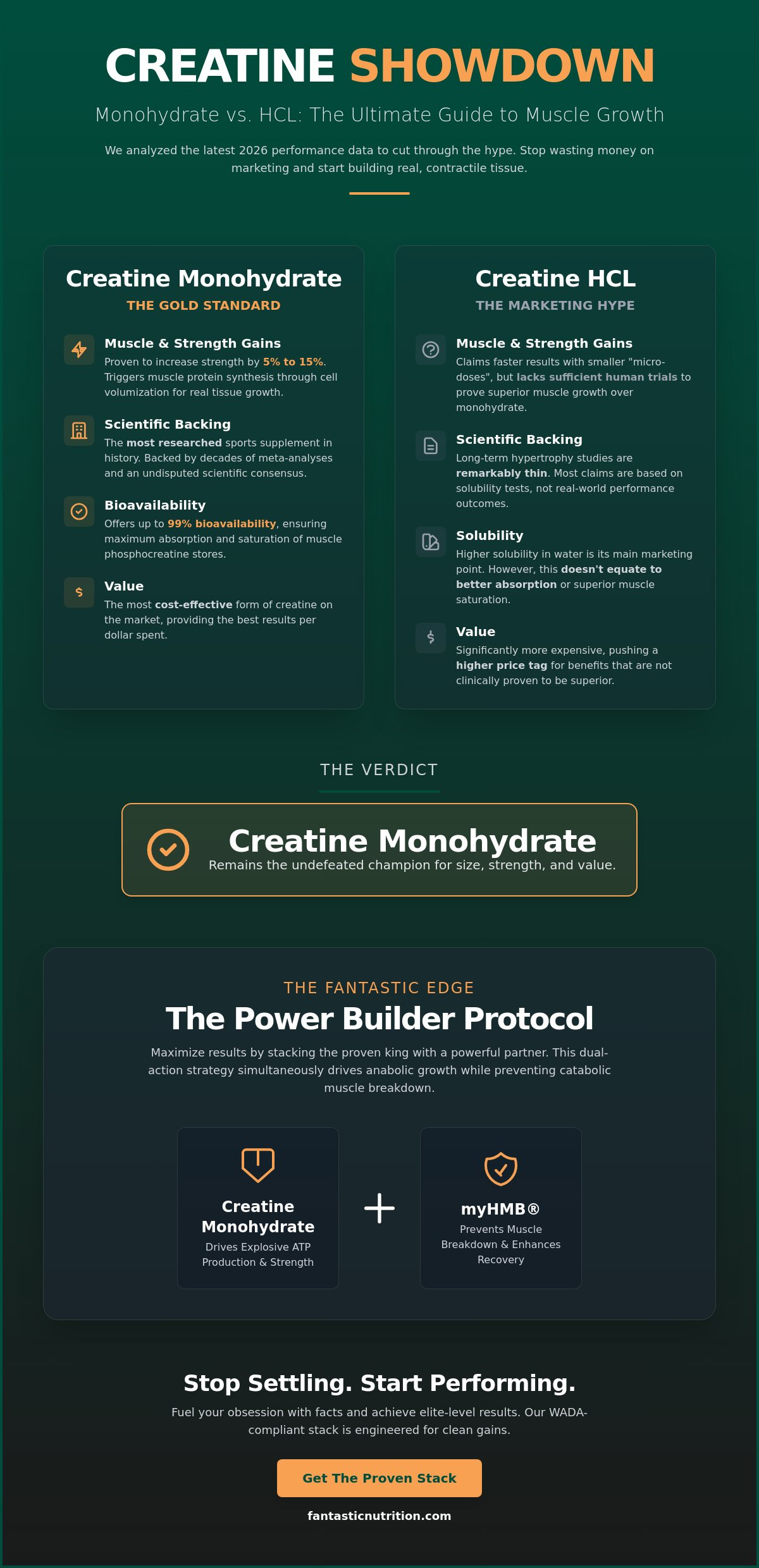
Creatine Monohydrate is, without a doubt, the most researched sports supplement in history. It consists of a creatine molecule bound to a single water molecule (hence, "mono-hydrate"). Its primary job is to help your body regenerate Adenosine Triphosphate (ATP), the main source of energy for short, explosive movements like lifting weights. (Creatine)
- How it works: By supplementing with monohydrate, you saturate your muscle's phosphocreatine stores. More stored phosphocreatine means you can produce ATP faster, allowing you to push out more reps and lift heavier over time.
- The bottom line: When you buy a high-quality, pure formula, creatine monohydrate has been shown to have a bioavailability of over 99%. It's the undisputed gold standard for a reason.
What is Creatine HCL?
Creatine Hydrochloride (HCL) is a newer form where a creatine molecule is bound to a hydrochloride group. This chemical bond lowers the pH, making it more acidic. The main marketing claim behind HCL is that this increased acidity enhances its solubility in water.
- The theory: Proponents claim that because HCL dissolves more easily, your body can absorb it more efficiently. This has led to the concept of "micro-dosing," where you take a much smaller serving (around 1.5g) compared to monohydrate's standard 5g.
- The question: Does better solubility in a glass of water automatically translate to better absorption and muscle saturation in the complex environment of the human stomach and intestines? The research is still playing catch-up.
Muscle Growth Showdown: Which Form Builds More Size?
When your primary goal is hypertrophy (muscle growth), the evidence is what matters. While both forms can support performance, the volume of research isn't even close. It's crucial to remember that no supplement can replace the fundamentals: consistent training, adequate sleep, and a clean, high-protein diet are the pillars of muscle growth.
The Gold Standard: Monohydrate’s Research Dominance
For decades, study after study has confirmed the effectiveness of creatine monohydrate for increasing lean body mass, strength, and power output. The results are incredibly consistent. (randomized clinical trials)
- Proven Results: An overwhelming body of research, including numerous meta-analyses, shows that athletes supplementing with creatine monohydrate consistently achieve significant strength gains, often cited in the 5-15% range over 8-12 week cycles.
- Cell Volumization: Monohydrate works by drawing water into the muscle cells. This process, known as cell volumization, is not just "water weight." It's a key anabolic signal that can trigger muscle protein synthesis and reduce protein breakdown, leading to real growth in contractile tissue.
- Smart Stacking: To maximize recovery and growth, pairing creatine with a clean protein source is essential. A high-quality whey provides the building blocks your muscles need to repair and grow after a creatine-fueled workout. For a complete breakdown, check out our 2026 Buyer’s Guide for Peak Performance.
Does HCL Offer a Growth Shortcut?
The core issue with Creatine HCL for muscle growth is the lack of long-term, direct comparison studies in humans. While the theory of better absorption is interesting, it hasn't been conclusively proven to lead to superior muscle gains over monohydrate.
- The Research Gap: There are very few long-term human trials that directly compare Creatine HCL to Creatine Monohydrate for changes in lean body mass and strength. The vast majority of muscle-building data points back to monohydrate.
- The Saturation Question: The ultimate goal of creatine supplementation is to reach the 'saturation point'—the moment your muscles are fully loaded with phosphocreatine. It remains unclear if the much lower, "micro-dosed" servings of HCL can achieve the same level of muscle saturation as the standard 5-gram dose of monohydrate.
- The "Non-Responder" Myth: Some people believe they are "non-responders" to monohydrate. While this can occur, it's often due to low-purity products with poor bioavailability. Before switching to HCL, most find success by simply using a higher-quality, third-party tested monohydrate.
Solubility, Bloating, and the Myth of the Loading Phase
The biggest marketing push for HCL revolves around avoiding the side effects commonly associated with cheap monohydrate: bloating and stomach discomfort. But is the creatine form the real culprit, or is it something else?
Here's a quick comparison: (Creatine supplements)
| Feature | Creatine Monohydrate | Creatine HCL |
|---|---|---|
| Research Level | Extensive (1000+ studies) | Limited |
| Price per Serving | Low | High |
| Solubility | Moderate | Very High |
| Bloat Risk | Low with pure forms; higher with fillers | Very Low |
Solving the 'Creatine Bloat' Problem
Let's be clear: the "bloat" from high-quality creatine is a good thing. It's water being pulled inside your muscle cells, making them fuller and supporting an anabolic environment. The uncomfortable, puffy feeling some people experience is often subcutaneous (under the skin) water retention, which is typically caused by two things:
- Low-Quality Supplements: Cheap creatine powders are often packed with high-sugar fillers, sodium, and other junk that can cause digestive distress and water retention.
- Dehydration: Not drinking enough water while taking creatine can also lead to issues.
The solution isn't necessarily to switch to HCL, but to choose a monohydrate that is verified for purity. Always look for supplements that use third-party lab verification to ensure you're not getting any hidden fillers.
Solubility and Serving Sizes
Creatine HCL absolutely dissolves better in water. There's no debating that. If you've ever had a chalky, gritty shaker cup from monohydrate, you know the difference. However, a simple trick—mixing your monohydrate with warm water or a beverage like tea—can solve the texture issue instantly.
For the ultimate convenience, many people mix their creatine directly into their post-workout protein shake. A clean, unflavored whey protein creates a seamless blend, delivering both your strength and recovery nutrients in one smooth, effective shake.
Practical Selection Guide: Matching Creatine to Your Goals
As a busy professional or parent, you don't have time for trial and error. You need to know what works. The truth is, for 95% of people, the choice is clear. But for a select few, HCL might be worth considering.
Who Should Choose Monohydrate?
- The Power Builder: If your goal is maximum strength and muscle size, monohydrate is the undisputed king. Its extensive research base guarantees results you can count on.
- The Budget-Conscious Athlete: Monohydrate offers the absolute best price-to-performance ratio in the supplement industry. You get proven results without paying a premium for marketing.
- The Long-Term Planner: Anyone following a traditional bulk and cut cycle will benefit most from monohydrate's ability to maximize cell volumization and strength gains. For a complete look at optimizing your supplement stack, see our Ultimate Guide to Protein Supplements.
When is HCL the Better Option?
- Those with Legitimate GI Distress: If you've tried a high-purity, third-party tested creatine monohydrate and still experience significant stomach discomfort, HCL is a reasonable alternative to try.
- The Pre-Competition Athlete: In the final days before a physique competition or photoshoot, some athletes prefer HCL to avoid even the slightest chance of subcutaneous water retention, however minimal it may be with a pure monohydrate.
A quick tip: while HCL requires less water for mixing, it requires just as much overall daily hydration to support performance and kidney function.
The Fantastic Edge: Why We Stack Monohydrate with myHMB
After reviewing all the evidence, we knew that Creatine Monohydrate was the superior choice for muscle growth. But we also asked: how can we make it even better? The answer was to address the other side of the muscle-building equation: preventing muscle breakdown.
That's why we created our innovative formula that combines pure Creatine Monohydrate with myHMB®.
The Synergy of Creatine and HMB
HMB (Beta-hydroxy beta-methylbutyrate) is a metabolite of the amino acid leucine. Its primary role is to slow down proteolysis, which is the natural breakdown of muscle protein. This creates a powerful dual-action effect:
- Creatine Monohydrate: Works to increase your strength and power output, promoting muscle protein synthesis (the "building" process).
- myHMB®: Works to decrease muscle protein breakdown (the "losing" process).
Clinical findings suggest that stacking Creatine and HMB helps athletes gain more lean mass and strength than using either supplement on its own. This combination is particularly effective for the 40+ demographic, helping to combat age-related muscle loss (sarcopenia) and accelerate recovery.
Purity Matters: Avoiding the 'Gunk'
The most advanced formula in the world is useless if it's loaded with junk. We're committed to clean, effective supplementation. That means we avoid artificial sweeteners like aspartame, unnecessary fillers, and anything that doesn't directly contribute to your performance.
Every single batch of our Creatine Monohydrate + myHMB is manufactured in a GMP-certified facility and verified by a Bozeman-based, third-party lab to guarantee what's on the label is what's in the tub. We're so confident in our research and our formula that we back it with a 100-day money-back guarantee.
You've done the hard work in the gym and the kitchen. Let us handle the science. Get Fantastic Nutrition and Live Fantastic!
Frequently Asked Questions
- Is creatine HCL better for muscle growth than monohydrate?
-
Based on the current body of scientific evidence, creatine monohydrate is superior for muscle growth. It has decades of research proving its effectiveness for increasing lean mass and strength, whereas HCL lacks sufficient long-term human studies to support the same claims.
- Does creatine monohydrate cause hair loss in 2026?
-
The link between creatine and hair loss is largely a myth based on a single, small study from 2009 that showed an increase in DHT, a hormone linked to male pattern baldness. This study has not been replicated, and major scientific bodies have found no conclusive evidence that creatine supplementation causes hair loss.
- Can I take creatine monohydrate without a loading phase?
-
Yes, absolutely. A loading phase (20g per day for 5-7 days) simply saturates your muscles faster. Taking a consistent maintenance dose (3-5g per day) will achieve the exact same muscle saturation point; it just takes a bit longer (about 3-4 weeks).
- What happens if I stop taking creatine for a week?
-
If you stop for a week, your muscle creatine stores will begin to decline slightly, but you won't lose the muscle you've built. It takes several weeks to a month for creatine levels to return to their baseline. You can simply resume your daily dose when you return.
- Is it safe to mix creatine with my morning coffee?
-
Yes, it is generally safe. The heat from the coffee can even help the creatine dissolve better. Early concerns about caffeine negating creatine's effects have not been supported by more recent, robust research.
- Does creatine HCL require a loading phase?
-
No. Because HCL is marketed with a much smaller "micro-dose" serving size, a loading phase is not part of its recommended protocol.
- How much water should I drink while taking creatine for muscle growth?
-
You should aim for adequate hydration regardless, but it's especially important with creatine. A good general guideline is to drink at least a gallon (3.8 liters) of water spread throughout the day to support creatine's function and overall health.
- Can women take the same dose of creatine as men?
-
Yes. The benefits of creatine—increased strength, improved recovery, and enhanced cognitive function—are not gender-specific. A standard 3-5 gram daily dose is effective and safe for both men and women looking to improve their performance.