
Collagen for Joint Repair and Recovery: The Science of Lasting Mobility
May 22, 2026 · Fantastic Nutrition

What if your morning joint stiffness isn't just an inevitable sign of aging, but a clear signal that your body's structural "glue" is failing to keep up with your ambition? Most people think of collagen as a beauty supplement for skin and hair, but the science tells a much more powerful story for athletes and active adults. You've likely felt that nagging ache after a heavy leg day or the frustration of a recovery process that seems to slow down every year. It's natural to worry that these small pains might eventually lead to a permanent loss of the mobility you value so much.
We understand that you don't want to slow down, and you shouldn't have to. You'll discover how clean-label collagen for joint repair and recovery acts as a metabolic signal, telling your body to actively rebuild connective tissue rather than just masking the discomfort. We've done the research for you, so you can stop guessing and start moving with confidence. This guide breaks down the latest 2026 data on peptide bioavailability, the importance of avoiding fillers, and the exact steps to help you bounce back faster and live fantastic.
Key Takeaways
- Understand why natural collagen synthesis hits a "cliff" after age 30 and how this shift impacts your cartilage and ligaments.
- Discover how hydrolyzed collagen for joint repair and recovery bypasses traditional digestion to trigger structural rebuilding at the cellular level.
- Learn why collagen peptides offer a distinct structural advantage over traditional supplements like glucosamine or chondroitin for lasting mobility.
- Identify the optimal daily dosage and the essential vitamin co-factor required to maximize your body's ability to repair connective tissue.
- Find out why clean-label, grass-fed sourcing is the only way to ensure your recovery is powered by pure ingredients without hidden fillers.
Understanding Joint Degradation and the Role of Collagen
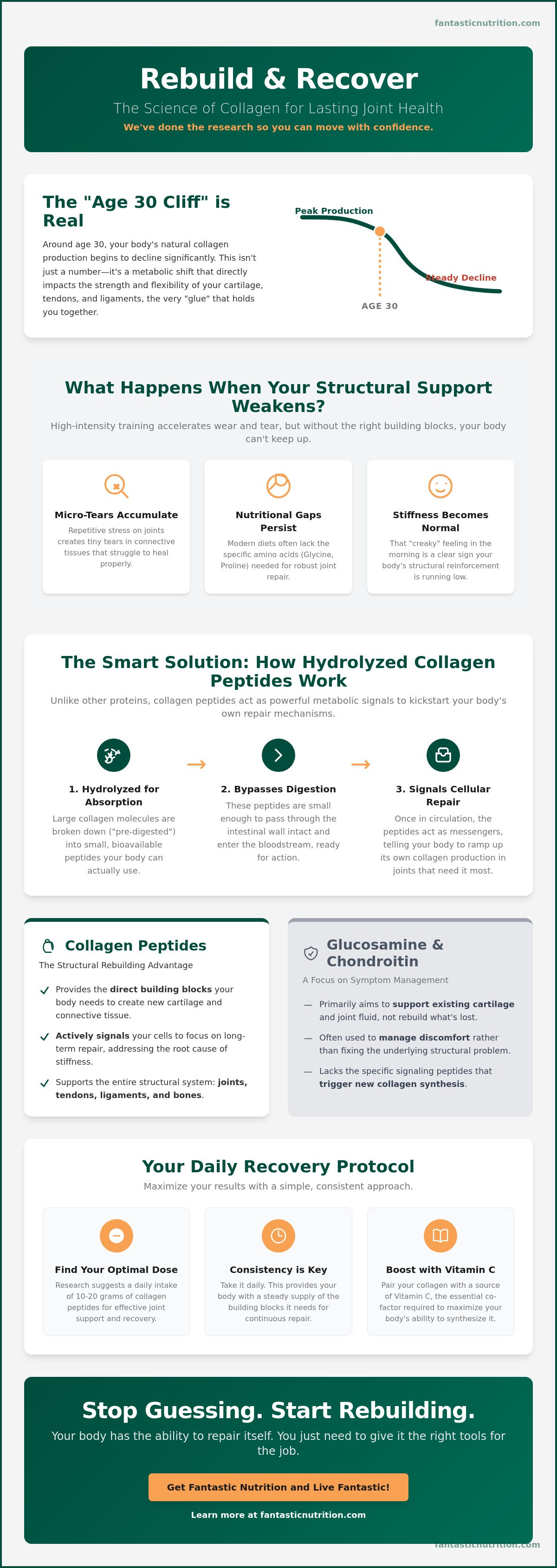
You've probably noticed that things don't "snap back" the way they did in your twenties. It isn't just in your head. Around age 30, your body's natural production of collagen begins to drop significantly. This "Age 30 Cliff" is a metabolic reality that affects your cartilage, tendons, and ligaments. Collagen is the primary structural protein that holds your body together; it's the framework that supports every move you make. To truly understand What is Collagen?, think of it as the biological glue for your entire skeletal system. Without it, the integrity of your joints begins to fade, leading to the discomfort many of us accept as "just getting older."
For those of us who hit the gym or the trails five days a week, this decline is even more noticeable. High-intensity training puts immense pressure on your connective tissues. While your muscles might grow stronger, the structural support system often struggles to keep pace. Using high-quality collagen for joint repair and recovery isn't just about fixing what's broken; it's about providing the building blocks you need to stay active and "Live Fantastic" well into your 60s. We've done the research for you, and the evidence shows that proactive nutrition is the best defense against long-term mobility loss.
The Anatomy of Joint Wear
Your cartilage acts as the ultimate shock absorber. It prevents bone-on-bone friction during every squat, run, and jump. However, years of repetitive stress create tiny micro-tears in your tendons and ligaments. These aren't just minor annoyances. When your body lacks the raw materials to patch these tears, you wake up with that familiar "creaky" feeling in your knees or shoulders. This morning stiffness is a red flag that your structural reinforcement is running low. Without adequate repair, these micro-tears can lead to more significant issues that keep you on the sidelines.
Why Diet Alone Often Falls Short
You might think you're getting enough protein from your daily steak or chicken breast, but muscle meats have a very different amino acid profile than connective tissue. Most modern diets have largely eliminated collagen-rich sources like bone broths, skin, and organ meats. This shift leaves a massive nutritional gap that your standard protein shake won't fill. Supplementing with Collagen Peptides provides a clean, efficient bridge. It ensures your joints have the specific glycine, proline, and hydroxyproline they need to thrive. It's the smartest way to support a high-performance lifestyle without overcomplicating your kitchen routine.
The Science of Collagen Peptides for Structural Repair
Most people think all protein is created equal. It's a common mistake. While your favorite steak provides amino acids, those acids are often used for general muscle maintenance rather than targeted joint work. This is where the specific science of collagen for joint repair and recovery changes the game. Unlike whole collagen proteins, which are long and difficult for the body to break down, hydrolyzed peptides are already "pre-digested" into smaller chains. These short chains don't just provide fuel; they act as biological messengers.
There's a persistent myth that collagen just becomes generic amino acids once it hits your stomach. Research suggests otherwise. These short peptide chains are small enough to pass through the intestinal wall intact. Once they enter your bloodstream, they don't just sit there. They signal your body to wake up its own repair mechanisms, specifically targeting areas where cartilage is thinning or ligaments are strained. Proline and Glycine provide the physical stability, while Hydroxyproline acts as the specific signal that tells your body to start building new tissue. It's not just food; it's information for your cells.
Type II Collagen: The Joint Specialist
Not all collagen is the same. While Type I is great for skin elasticity and bone density, Type II is the primary protein found in your cartilage. It's the specialist your joints need to stay cushioned and mobile. A well-rounded approach ensures you're addressing the shock absorbers in your knees and hips. This specific structural support is a cornerstone of why Collagen Peptides Powder has become a staple for high-performance athletes. Even the Arthritis Foundation on collagen supplements notes the distinction between types and their potential for supporting long-term joint health.
Bioavailability and the Hydrolyzation Process
Hydrolyzation sounds like a complex lab term, but it’s actually quite simple. It's the process of using water and enzymes to break down large protein molecules into "bite-sized" pieces. These smaller pieces are what we call peptides. Because they have a lower molecular weight, your body can absorb them much faster than traditional protein sources. This speed is vital when you're looking for a quick bounce-back after a heavy lifting session. Bioavailability is the percentage of a nutrient that actually reaches the target tissue. By choosing hydrolyzed sources, you’re ensuring that more of the supplement actually ends up in your connective tissues rather than being wasted. If you want to see how these clean ingredients fit into your lifestyle, check out our Collagen Peptides for a straightforward, filler-free solution.
Collagen vs. Traditional Joint Supplements: What Works?
If you've ever walked down the supplement aisle, you've seen the massive bottles of Glucosamine and Chondroitin. For years, these were the only options for anyone dealing with creaky knees. While they can help with joint lubrication, they don't always address the underlying structural damage. This is where collagen for joint repair and recovery takes a different path. Instead of just trying to grease the gears, collagen provides the actual raw materials needed to rebuild the gears themselves. It's the difference between temporary relief and long-term structural integrity.
A recent scientific review of collagen for joint health highlights how hydrolyzed collagen specifically supports the cells responsible for maintaining cartilage. While traditional anti-inflammatories like Turmeric are fantastic for managing immediate pain, they don't provide the building blocks your body craves. You need a solution that manages the "fire" while simultaneously rebuilding the "house." By using collagen for joint repair and recovery, you're giving your body the specific amino acids it can't get in high enough concentrations from a standard diet or synthetic joint complexes.
The Synergy of Collagen and Whey
Think of your body like a high-performance car. Your muscles are the engine, but your joints and tendons are the frame. To keep the whole machine running, you need to support both. Taking Grass Fed Whey Protein alongside your collagen is the ultimate recovery stack. While whey provides the complete amino acid profile for muscle repair, collagen targets the connective tissues. This combination ensures that your frame is as strong as your engine. It allows you to push harder during your workouts without the nagging fear of structural breakdown. It's about total body repair, not just muscle growth.
Avoiding the "Filler Trap" in Joint Formulas
Many "all-in-one" joint complexes are loaded with junk you simply don't need. We're talking about maltodextrin, artificial sweeteners, and synthetic colors that can actually trigger inflammation. It's a massive contradiction to take a joint supplement that contains ingredients that make you feel worse. At Fantastic Nutrition, we stick to a clean-label approach. Our Collagen Peptides are free from fillers and hidden sugars. You get exactly what you need for peak performance and nothing else. We've done the research for you, so you can focus on hitting your next goal with total confidence and a clear conscience.
The Recovery Protocol: How to Optimize Your Collagen Intake
Knowing the science is one thing; putting it into practice is where the real transformation happens. To see genuine results from collagen for joint repair and recovery, you need to treat it like any other part of your training. It isn't a "take it when you feel like it" supplement. For most active adults, the research points to a daily dosage of 10 to 20 grams. This range provides enough amino acids to saturate your connective tissues and signal those repair mechanisms we discussed earlier. If you're hitting the gym five days a week, aim for the higher end of that scale to keep up with the metabolic demand.
One detail that many people miss is the critical role of Vitamin C. Think of Vitamin C as the "on switch" for collagen synthesis. Without it, your body struggles to cross-link those amino acids into strong, resilient fibers. You don't need a massive dose, but having some Vitamin C in your system when you take your collagen is a non-negotiable for efficacy. We also recommend avoiding the temptation to "pulse" your dosage. While you might be used to cycling other supplements, your joints require a steady, daily supply of raw materials to maintain their structural integrity over the long haul.
Timing Your Dose for Maximum Impact
Timing can give you a slight but significant edge. Research suggests that taking your collagen 30 to 60 minutes before exercise may be the sweet spot. During your workout, blood flow to your tendons and ligaments increases, which helps "drive" those peptides into the tissues that need them most. Many of our community members start their day with a "vitality scoop" in their morning coffee to set a structural tone for the day. For a complete post-workout recovery boost, you can easily mix your peptides into a serving of Unflavored Whey. This combination covers both your muscle repair and your joint support in one simple step.
Measuring Success: What to Expect and When
We believe in being honest about timelines. You'll likely see improvements in your skin and nails within about four weeks, but joint repair takes longer. You should expect to stay consistent for 8 to 12 weeks before you notice a significant difference in how your knees or shoulders feel during a heavy lift. Structural repair is a slow biological process that requires daily commitment and patience. You'll know it's working when that morning "clicking" starts to fade and your range of motion feels smoother during your warm-up sets. If you're ready to start your own protocol, you can find our pure, filler-free Collagen Peptides here to ensure you're getting the highest quality building blocks available.
Why Clean-Label Collagen is Vital for Your Fantastic Life
You've seen the science and you've got the protocol. Now, the final piece of the puzzle is the quality of the actual powder in your scoop. Not all collagen for joint repair and recovery is created equal. Many products on the market use "commodity collagen" sourced from factory-farmed animals. This often leads to a lower-quality amino acid profile and the potential for unwanted trace contaminants. We believe that if you're putting in the work at the gym, your body deserves ingredients that are as clean as your intentions. That's why we insist on grass-fed, pasture-raised sourcing for every batch.
The supplement industry is notorious for the "filler problem." It's common to find maltodextrin, artificial sweeteners, or flow agents tucked away in the "other ingredients" list. These additives can cause gut inflammation, which is the last thing you want when you're trying to heal your joints. We take a different approach. Fantastic Nutrition is committed to third-party lab verification for purity and potency. We act as your trusted friend in the industry; we've done the research for you so you can focus on your performance. Even our packaging is designed with your values in mind; we use recyclable materials because a healthy life and a healthy planet go hand in hand.
The Bozeman Standard: Quality Without Compromise
Our roots are in Bozeman, Montana. Being based in a place defined by outdoor achievement shapes how we do business. We use a direct-to-consumer model, which is a fancy way of saying we cut out the middlemen. By eliminating the markups from big-box retailers and distributors, we can invest more into the quality of our ingredients. This allows us to provide premium, grass-fed peptides at a value that actually makes sense for your daily routine. You can learn more about our journey and our commitment to these standards on our About Us page.
Live Fantastic: Your Next Steps
Transitioning from daily joint discomfort to structural vitality is a journey. It starts with understanding that your body isn't "broken"; it just needs the right tools to rebuild. By choosing a clean-label mindset, you're taking control of your health and ensuring that you can keep hitting your fitness goals for decades to come. You have the knowledge, the timing, and the science. Now, it's time to take action. Shop Fantastic Collagen Peptides today and give your joints the high-performance support they've been waiting for. It's time to get Fantastic Nutrition and live fantastic!
Take Charge of Your Structural Future
Stop accepting morning stiffness as your new normal. You've learned that your body needs specific signals and raw materials to maintain its frame. By choosing hydrolyzed peptides over whole proteins, you're giving your cells the exact messengers they need to trigger repair. Consistency is your greatest ally; daily support beats occasional high doses every time. Using high-quality collagen for joint repair and recovery ensures you aren't just masking pain, but actively reinforcing your cartilage and tendons for the years ahead.
We've done the heavy lifting on the research so you can focus on your training. Our peptides are third-party lab verified for purity and sourced from grass-fed, pasture-raised cattle. You won't find any added sugars, hidden fillers, or artificial junk in our bags; just the clean ingredients your body craves. It's time to stop worrying about your mobility and start investing in it. Your best workouts are still ahead of you. Take the next step toward a pain-free lifestyle and feel the difference that real quality makes.
Get Fantastic Nutrition and Live Fantastic!
Frequently Asked Questions
Is collagen for joint repair better than glucosamine?
Collagen offers a more comprehensive approach because it provides the actual amino acids needed to rebuild the structural framework of your joints. While glucosamine primarily focuses on maintaining joint fluid and lubrication, collagen addresses the cartilage and tendons themselves. Many active adults find that collagen for joint repair and recovery delivers better long-term results by reinforcing the "frame" of the body rather than just temporary lubrication.
How long does it take for collagen to repair joints?
You should expect to stay consistent for 8 to 12 weeks to feel a significant difference in joint comfort and mobility. While you might see improvements in your skin or nails within 4 weeks, connective tissue repair is a slower biological process. Your body needs time to integrate those peptides into the cartilage and ligaments that support your high-performance lifestyle.
Can I take collagen and whey protein together for recovery?
You absolutely can, and we actually recommend it for total body repair. Whey protein is the gold standard for muscle protein synthesis, while collagen specifically targets the tendons, ligaments, and cartilage that hold those muscles in place. Mixing them into one shake creates a powerful recovery stack that supports both your engine and your frame simultaneously.
Does collagen help with muscle recovery after a workout?
Collagen's primary job is supporting connective tissue, but it plays a vital supporting role in overall recovery. It contains glycine and arginine, which are involved in natural creatine synthesis and cellular energy. However, for direct muscle tissue repair, it's best to pair your collagen with a high-quality whey protein to ensure you're getting a full spectrum of branched-chain amino acids.
What is the best time of day to take collagen for joints?
The most effective window is 30 to 60 minutes before your workout. This timing takes advantage of the increased blood flow to your connective tissues during exercise, which helps "drive" the peptides into the areas that need them most. On rest days, a morning dose is perfect for keeping your structural repair move-ready and consistent.
Are there any side effects to taking collagen peptides daily?
Collagen is a natural protein and is generally very safe for daily use. Some individuals might experience mild bloating if they start with a very high dose, but this is rare with clean-label products. Choosing a formula free from artificial sweeteners and fillers significantly reduces the risk of digestive upset, allowing you to focus on your performance.
Is grass-fed collagen actually better for joint health?
Purity is everything when you're looking for long-term results. Grass-fed, pasture-raised sourcing ensures your collagen for joint repair and recovery is free from the hormones and antibiotics often found in factory-farmed alternatives. This higher standard of sourcing provides a clean amino acid profile that your body can efficiently use to rebuild and protect your joints.
Can collagen help prevent future joint injuries?
Proactive supplementation helps strengthen the structural integrity of your tendons and ligaments, which can reduce the risk of common strains and tears. By consistently providing your body with the specific building blocks of connective tissue, you're building a more resilient frame. It's a smart strategy for anyone who wants to stay active and live fantastic for decades to come.