
All Natural Protein Powder: The 2026 Guide to Clean Nutrition Without the Fillers
August 01, 2026 · Fantastic Nutrition
What if the cleanest all natural protein powder on the market is actually defined by what's not in it? Flip over almost any tub at your local supplement store and you'll find a wall of text: artificial sweeteners, mystery fillers, and ingredients you can't pronounce. You train hard, you eat well, and then you hand all of that effort over to a product loaded with junk that leaves you bloated, second-guessing every label, and wondering whether you just wasted another $60.
You're right to be skeptical. The supplement industry has a long history of dressing up mediocre products in "natural" marketing language while the actual ingredient list tells a very different story.
Here's the good news: finding a genuinely clean protein source isn't complicated once you know exactly what to look for. In this guide, you'll learn how to decode supplement labels like a pro, identify the red flags that separate real clean nutrition from clever packaging, and discover why a shorter, simpler ingredient list is the single most reliable sign of a protein powder that will actually support your goals.
Key Takeaways
- The term "natural" on a supplement label means almost nothing on its own — you'll learn the specific markers that separate a genuinely clean all natural protein powder from clever marketing spin.
- Reading a supplement facts panel is a skill, and once you know what the amino acid profile is actually telling you, you'll never choose a protein powder the same way again.
- Whey and plant-based proteins each have a place in a smart nutrition plan — discover which source matches your body, your goals, and your lifestyle.
- Retail pricing inflates what you pay without improving what's inside the tub; find out how buying direct puts better ingredients in your hands for less money.
- A shorter ingredient list isn't a compromise — it's the clearest sign that a protein powder is built to perform, not just to sell.
What Is All Natural Protein Powder (And Why Does It Matter)?
"All natural" sounds simple enough. But walk into any supplement store and you'll find that phrase plastered on products packed with ingredients that belong in a chemistry textbook, not your post-workout shake. The term has no strict regulatory definition from the FDA when applied to supplements, which means manufacturers use it freely, regardless of what's actually inside the tub.
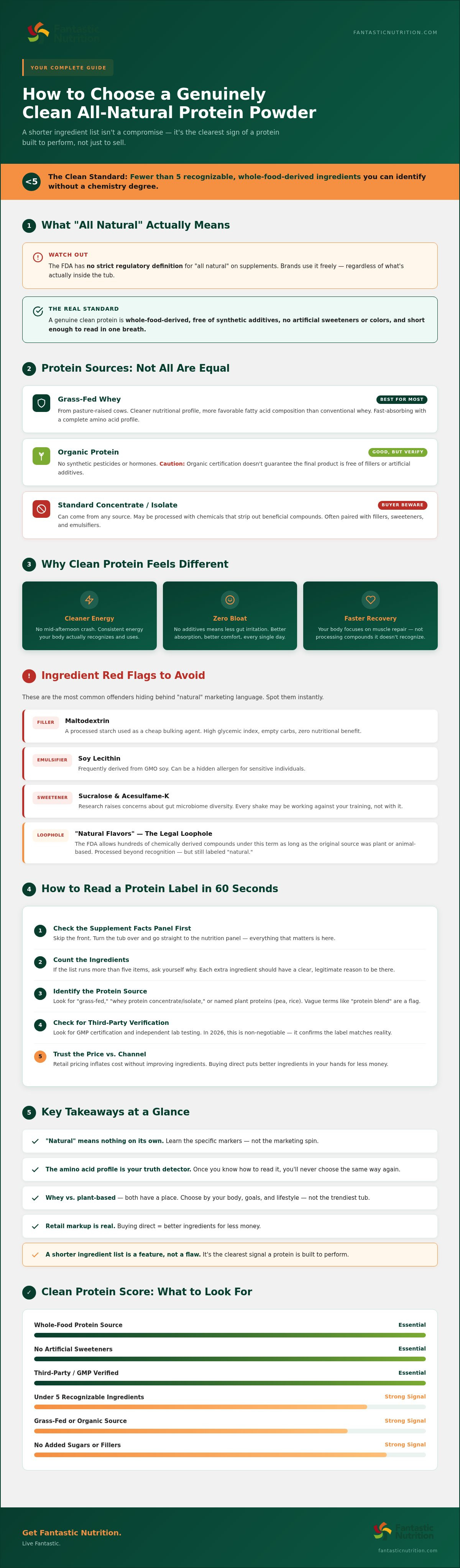
So let's define it properly. A genuine all natural protein powder is built from whole-food-derived protein sources, contains no synthetic additives, uses no artificial sweeteners or colors, and keeps its ingredient list short enough that you can actually identify every item on it. That's the real standard, and it's a meaningful one.
The source of your protein matters here, too. Not all protein is created equal:
- Grass-fed whey comes from cows that graze on pasture rather than eating grain-based feed. The result is a protein with a cleaner nutritional profile and a more favorable fatty acid composition compared to conventional whey.
- Organic protein means the source ingredient was grown or raised without synthetic pesticides or hormones, but organic certification doesn't automatically mean the final product is free of fillers or artificial additives.
- Standard protein concentrate or isolate can come from any source and may be processed with chemicals that strip out beneficial compounds along with the unwanted ones.
Your body processes clean-label protein more efficiently because it's not spending resources managing compounds it doesn't recognize. Fewer additives means less gut irritation, better absorption, and a faster path to the muscle repair and recovery you're actually training for.
There's a bigger picture, too. When your nutrition is genuinely clean, you feel it. Clearer energy. No afternoon bloat. The kind of day-to-day consistency that makes it easier to show up for your workouts, your family, and everything else on your plate. That's what it means to Live Fantastic, and it starts with what you put in your body.
The Problem with "Natural Flavors" and Fillers
Here's the loophole most supplement brands quietly exploit: the FDA allows manufacturers to list hundreds of chemically derived compounds under the umbrella term "natural flavors," as long as the original source was plant or animal-based. That source could be processed beyond recognition, but the label still reads "natural." It's technically legal. It's also misleading.
Beyond natural flavors, watch for these common fillers in your ingredient panel:
- Maltodextrin: A processed starch used as a cheap bulking agent. It has a high glycemic index and adds empty carbohydrates with no nutritional benefit.
- Soy lecithin: Often used as an emulsifier, it's frequently derived from genetically modified soy and can be a hidden allergen for sensitive individuals.
- Artificial sweeteners (sucralose, acesulfame-K): Research published in journals like Nature has raised questions about their effect on gut microbiome diversity. If you're training hard and eating well, disrupting your gut health with every shake is counterproductive.
The 2026 Standard for Clean Supplements
Third-party lab verification used to be a nice-to-have. In 2026, it's non-negotiable. Independent testing confirms that what's on the label is actually in the product and that nothing else is hiding in there. Good Manufacturing Practices (GMP) certification adds another layer of accountability, ensuring the facility producing your protein meets consistent quality and safety standards throughout every batch.
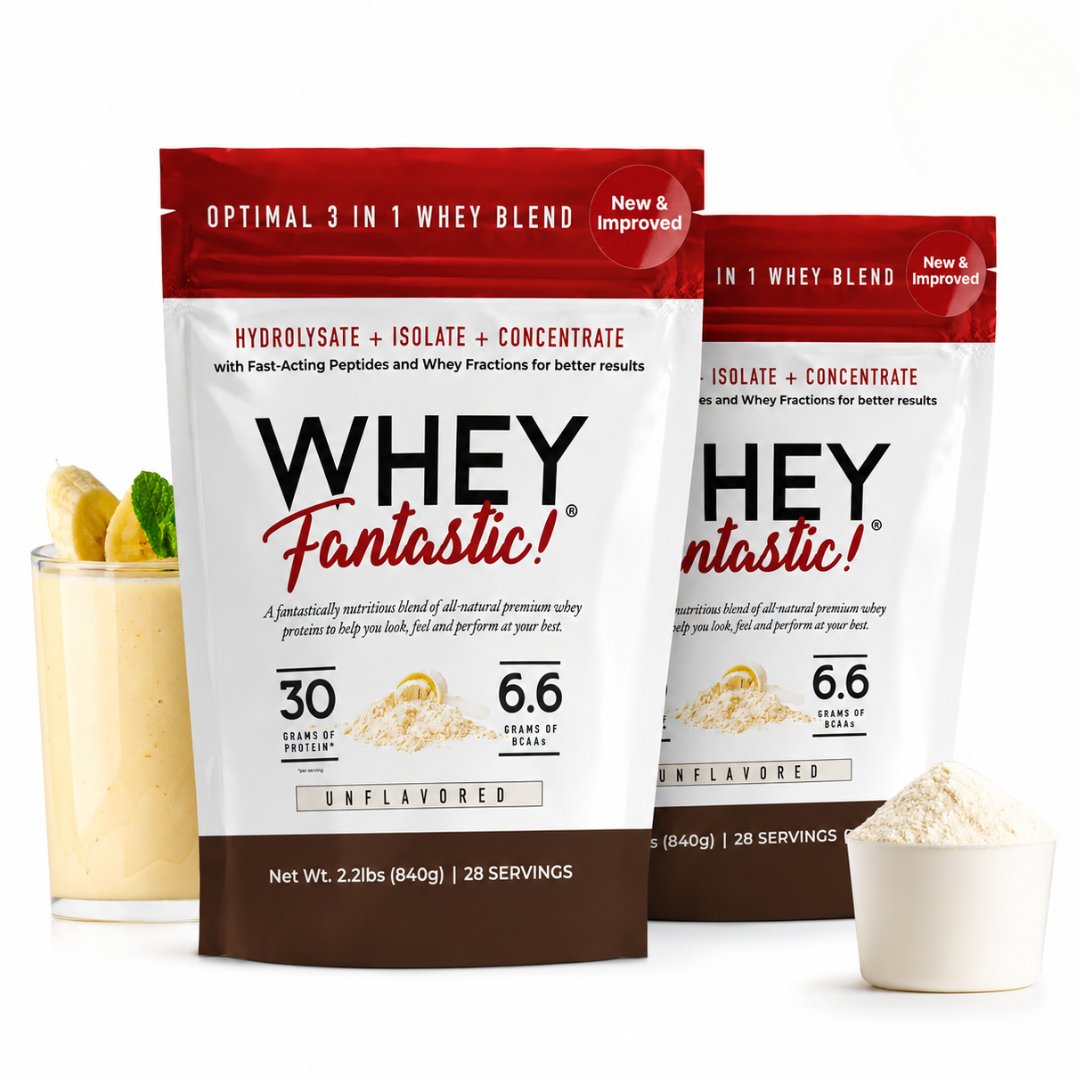
By this standard, a truly clean protein is straightforward to define: a supplement with fewer than five recognizable, whole-food-derived ingredients that you can identify without a chemistry degree. That's the bar. Fantastic Nutrition's Grass-Fed 3-in-1 Whey Protein Blend is built to clear it, manufactured under strict GMP guidelines and third-party verified for purity so you know exactly what you're getting with every scoop.
The Anatomy of a Premium Protein Label
Pick up a tub of protein powder and turn it over. What you're looking at in the next 60 seconds will either confirm you've found a genuinely clean product or reveal that you're about to pay a premium price for a mediocre one. Knowing how to read that label isn't complicated, but most people skip it entirely and rely on whatever's printed on the front.
Start with the supplement facts panel. The first thing to check is the protein percentage: divide the grams of protein per serving by the total serving size in grams. A high-quality whey should land at 70 percent or above. Anything significantly lower means something else is filling that scoop, and you deserve to know what it is.
Next, scan the amino acid profile. This is where the real story lives. Muscle repair and recovery depend on a full spectrum of essential amino acids, particularly leucine, isoleucine, and valine — the branched-chain amino acids (BCAAs) that trigger muscle protein synthesis. A protein powder that skimps on its amino acid disclosure, or doesn't list one at all, is a product that doesn't want you looking too closely.
Hidden sugars are the other trap. They show up under names like dextrose, glucose syrup, cane juice solids, and maltose. These aren't just empty calories; they're the reason you feel a sharp energy spike followed by a mid-afternoon crash that wrecks your afternoon. A truly clean all natural protein powder won't need added sugars to taste good, because the quality of the protein source does that work on its own.
The Grass-Fed Advantage
Grass-fed isn't a marketing badge. It's a meaningful quality signal tied directly to how the animal lived. Whey from pasture-raised cows contains higher concentrations of omega-3 fatty acids and conjugated linoleic acid (CLA) compared to conventional grain-fed sources. Both compounds support healthy inflammation response and body composition. The animal's diet shapes the nutritional density of what ends up in your shake, which is why sourcing matters as much as processing.
Sustainable pasture farming also tends to produce more nutrient-dense milk because grazing cattle consume a wider variety of grasses and plants than feedlot animals eating a uniform grain diet. That variety translates into a richer micronutrient profile in the final product.
Non-GMO and Soy-Free: Why It Matters
Soy is one of the most common fillers and emulsifiers in the supplement industry, and it's frequently sourced from genetically modified crops. For both men and women, regular consumption of soy-derived compounds has raised questions among researchers regarding their effect on hormonal balance, specifically around phytoestrogen activity. That's a conversation worth having before you commit to a daily shake.
Non-GMO ingredients matter for long-term foundational health because they reduce your cumulative exposure to agricultural chemicals associated with genetically modified crop production. Fantastic Nutrition's Grass-Fed 3-in-1 Whey Protein Blend is non-GMO, gluten-free, and soy-free, which means it sidesteps the most common allergen and additive pitfalls in a single formulation. That's not an accident. It's the result of building a product around what serious, health-conscious people actually need.
Once you know how to read a label this way, choosing a genuinely clean protein becomes straightforward. The short ingredient list stops looking like a limitation and starts looking like exactly what it is: a sign of confidence in the quality of what's inside.
Whey vs. Plant-Based: Choosing Your Natural Fuel
The protein debate has a clear answer for most people, but not the one the internet usually gives you. It's not about which source sounds cleanest or which influencer endorses it. It's about what your body can actually use, and how that changes as you age.
Bioavailability and Muscle Protein Synthesis
Whey remains the most bioavailable protein source available. That's not brand loyalty talking; it's physiology. Whey digests quickly, floods the bloodstream with amino acids within 30 to 60 minutes of consumption, and delivers a leucine concentration that plant sources simply can't match gram-for-gram. Leucine is the key trigger for muscle protein synthesis, and hitting the threshold your body needs to actually build and repair muscle tissue requires a meaningful dose of it per serving.
Most plant proteins, including pea and rice, contain leucine, but at lower concentrations. You'd need a larger serving to achieve the same anabolic signal, and even then, plant proteins are often incomplete on their own, meaning they're missing one or more essential amino acids. Combining pea with rice protein addresses that gap, which is why well-formulated plant blends are a legitimate option for those avoiding dairy entirely.
Here's the part that doesn't get enough attention: protein utilization shifts after 35. Muscle protein synthesis becomes less efficient, a phenomenon researchers call anabolic resistance. Your body needs more high-quality protein stimulus to produce the same muscle-building response it managed easily at 25. That's a compelling reason to prioritize a high-leucine, fast-absorbing source like grass-fed whey, rather than settling for a lower-quality all natural protein powder that looks clean on the label but underdelivers in the body.
You can improve absorption naturally without any chemical additives. Consuming protein within 45 minutes of training, pairing it with digestive-enzyme-rich whole foods like pineapple or papaya, and staying well-hydrated all support better uptake without complicating your ingredient list.
The Synergy of Protein and Collagen
Muscle recovery is only part of the equation. Anyone in the 30-to-60 window who trains consistently knows the other part: joints, tendons, and connective tissue that take longer to recover than they used to. That's where collagen peptides become a smart addition to a protein-focused nutrition plan.
Collagen is the most abundant structural protein in the human body, and its natural production declines steadily after your mid-20s. Supplementing with collagen peptides supplies the specific amino acids, particularly glycine and proline, that your body uses to maintain and repair cartilage, tendons, and ligaments. These aren't the same amino acids that drive muscle growth, which is exactly why collagen and whey work better together than either does alone.
Think of it as a complete recovery stack built from natural ingredients:
- Grass-fed whey: Fast-absorbing, leucine-rich, drives muscle protein synthesis
- Collagen peptides: Supports joint integrity, skin elasticity, and connective tissue repair
- Creatine: Enhances strength output and supports lean mass retention, especially relevant as natural creatine stores decline with age
This combination addresses the full picture of what active adults in their 30s, 40s, and 50s actually need from their nutrition, not just the muscle-building headline, but the structural support that keeps you training consistently without breaking down in the process.
As for taste: yes, a genuinely clean protein can taste fantastic. The assumption that natural means chalky or bland belongs to an earlier era of supplement formulation. When you start with a high-quality grass-fed whey base and skip the artificial sweeteners, the result is a cleaner, more natural flavor that doesn't leave a chemical aftertaste. That's not a compromise. That's what good ingredients actually taste like.
How to Shop for Natural Protein Without Getting Scammed
Most people shop for protein the same way they shop for everything else: they check Amazon reviews, look for a recognizable name, and assume the highest-rated product is the best one. That approach works fine for phone cases. It doesn't work for supplements, where reviews can be incentivized, labels are loosely regulated, and the retailer standing between you and the manufacturer adds cost without adding quality.
Here's what actually matters when you're evaluating an all natural protein powder: where it comes from, how it's verified, and whether the brand is willing to be transparent about both.
The direct-to-consumer model exists for a reason. When a brand sells directly to you, it controls the entire chain from sourcing to your doorstep. There's no retail buyer demanding a lower cost-per-unit that quietly pushes the manufacturer toward cheaper ingredients. There's no warehouse sitting on inventory for months before it reaches a shelf. Fresher product, cleaner formulation, and a brand that has to stand behind what it makes because there's no retailer to absorb the complaints.
Retail markup is real, and it's significant. A product that costs a supplement company a certain amount to produce doesn't double in price because the ingredients improved. It doubles because a distributor, a regional broker, and a retail chain each take their cut before the tub reaches your hands. You're paying the "middleman tax" every time you grab a protein off a big-box shelf, and none of that extra cost is going toward better sourcing.
Red flags to watch for when browsing online retailers:
- No ingredient transparency: If the full ingredient list isn't visible before purchase, that's not an accident.
- Proprietary blends without disclosed ratios: A blend that lists "protein matrix" without individual amounts makes it impossible to evaluate what you're actually getting.
- No mention of third-party testing: Any brand serious about clean-label claims will say so clearly and be able to back it up.
- Suspiciously low prices: Quality sourcing costs money. A price that seems too good usually means something in the formulation was compromised to hit it.
Evaluating Price vs. Value
The number on the front of the tub means nothing without context. Divide the grams of protein per serving by the total serving size in grams to get your protein efficiency ratio. Then calculate the cost per gram of actual protein delivered, not scoop size. A slightly higher price point on a product with superior sourcing, verified purity, and no fillers often delivers better value than a cheaper tub that's padded with maltodextrin and delivers less usable protein per dollar spent. Subscription models add another layer of value here: consistent delivery, often at a reduced price, and the kind of foundational routine that actually moves the needle on long-term health.
The Role of Third-Party Testing
Third-party testing is the only way to verify a "clean label" claim, full stop. A brand can print anything on a tub. An independent lab can't be paid to lie about what's in it. When evaluating a lab report, look for three things: heavy metals testing (lead, cadmium, arsenic, mercury), potency verification (does the product actually contain the protein amount stated on the label), and purity confirmation (no undisclosed compounds or contaminants). Fantastic Nutrition's Grass-Fed 3-in-1 Whey Protein Blend is third-party verified for purity and manufactured under strict GMP guidelines. The research has already been done for you. That's not a marketing line; it's a commitment to the standard you deserve from every product you put in your body.
Smart shopping isn't complicated once you know the rules. Demand transparency, calculate real value, and only trust brands that can prove their claims with independent verification. Explore Fantastic Nutrition's full lineup and see exactly what clean-label sourcing looks like in practice.
Live Fantastic: The Fantastic Nutrition Difference
Some supplement companies are built around a product. Fantastic Nutrition is built around a belief: that you deserve to know exactly what you're putting in your body, and that clean nutrition shouldn't require a chemistry degree to verify. That belief lives in every scoop of the Grass-Fed 3-in-1 Whey Protein Blend, and it shapes everything the Bozeman-based team does, from sourcing decisions to the label itself.
The "3-in-1" isn't marketing shorthand. It reflects a deliberate formulation philosophy: one product that delivers fast-absorbing whey protein concentrate, whey protein isolate, and whey protein hydrolysate in a single, clean blend. Three complementary protein fractions. One short ingredient list. Zero compromises on quality. That's how a genuinely well-designed all natural protein powder simplifies your routine without dumbing it down.
And the taste? Genuinely fantastic. Achieving a clean vanilla flavor without artificial sweeteners, sucralose, or acesulfame-K required real formulation work, not a shortcut through a chemical flavor lab. The result is a smooth, natural flavor that doesn't leave a synthetic aftertaste, because it doesn't contain any. Good ingredients, done right, taste like exactly that.
A Clean Label You Can Trust
No added sugars. No fillers. No bro speak. Just results. The packaging is recyclable, the sourcing is transparent, and the label reads the way a supplement label should: short, recognizable, and honest. When Fantastic Nutrition says "clean label," it means the kind of clean that holds up under a third-party lab report, not just under a marketing brief. GMP manufacturing and independent purity verification aren't optional extras here. They're the baseline.
Your Journey to a Fantastic Life
Fantastic Nutrition isn't just selling protein. It's a resource for active adults who want to look and feel younger, train consistently, and build the kind of foundational health that compounds over time. That's why the product lineup is designed to work together. Pair the Grass-Fed 3-in-1 Whey Protein Blend with Creatine Monohydrate plus myHMB and you're addressing both the muscle-building signal and the lean mass retention that becomes increasingly important after 35. Creatine drives strength output. HMB helps preserve the muscle you've already built. Together, they amplify what the protein is already doing.
The research has been done for you. The sourcing decisions have been made with your long-term health in mind. All that's left is the decision to stop settling for a cluttered label and a mediocre shake.
Get Fantastic Nutrition. Live Fantastic.
Your Next Step Toward Cleaner, Smarter Nutrition
You now have everything you need to stop guessing and start choosing with confidence. Reading a label is a skill. Knowing the difference between clever marketing and genuine clean-label formulation is a standard. And understanding that a shorter ingredient list is a sign of strength, not compromise, changes how you shop forever.
The bottom line is straightforward: a genuinely clean all natural protein powder is third-party verified, built from research-backed formulas designed for active adults aged 30 to 60, and priced fairly because it comes directly to you without a retailer taking a cut along the way. That's not a wish list. That's exactly what Fantastic Nutrition delivers.
You train hard. You deserve nutrition that works just as hard. Don't settle for a label you can't trust or a formula that undermines everything you're building.
Get Fantastic Nutrition and Live Fantastic!
Frequently Asked Questions About All Natural Protein Powder
Is all natural protein powder as effective as regular protein?
Yes, and in many cases it performs better. A genuinely clean all natural protein powder delivers the same essential amino acids as conventional options without the artificial additives that can interfere with digestion and nutrient absorption. When your gut isn't managing synthetic compounds with every serving, your body can focus on what actually matters: repairing muscle tissue and recovering from training.
The key is verifying that "natural" means something real on the label. A short, recognizable ingredient list combined with third-party purity verification is the clearest sign that you're getting effective nutrition, not just effective marketing.
What is the best natural sweetener for protein powder?
Monk fruit and stevia are the two most common natural sweetener options in clean-label supplements. Both are plant-derived, calorie-free, and don't carry the gut microbiome concerns associated with artificial sweeteners like sucralose. Monk fruit tends to have a cleaner finish with less bitterness than stevia at higher concentrations, making it a popular choice in premium formulations.
That said, a well-sourced unflavored whey protein can taste surprisingly clean on its own, without any sweetener at all. If you want full control over what goes in your shake, an unflavored option gives you exactly that.
Can I use all natural protein powder for weight loss?
Absolutely. Protein is one of the most satiating macronutrients, which means it helps you stay fuller longer and reduces the likelihood of overeating later in the day. A clean protein powder with no added sugars and no maltodextrin fillers supports a calorie-controlled diet without spiking blood sugar or adding empty carbohydrates that work against your goals.
The practical approach is straightforward: use a high-quality protein shake to replace a higher-calorie meal or snack, hit your daily protein target consistently, and let the satiety effect do its job. Consistency matters far more than any single ingredient.
Does grass-fed whey really make a difference in muscle growth?
The muscle-building mechanism is the same regardless of source: leucine triggers muscle protein synthesis, and whey delivers it efficiently. Where grass-fed whey distinguishes itself is in the broader nutritional profile. Higher omega-3 content and conjugated linoleic acid (CLA) support a healthier inflammatory response, which means better recovery between sessions and a body that's better equipped to actually build the muscle you're training for.
Think of it this way: the protein drives the growth signal, and the cleaner nutritional environment around it helps you recover faster and train more consistently. That compounding effect adds up significantly over months of training.
Is natural protein powder safe for people with sensitive stomachs?
For most people with digestive sensitivity, a clean-label protein is actually easier to tolerate than conventional options. Many gut issues attributed to protein powder are actually reactions to the additives, not the protein itself. Artificial sweeteners, soy lecithin, and certain gums are common culprits. Removing them from the formulation removes the trigger.
If you're lactose-sensitive, whey protein isolate is worth looking for specifically. The isolation process removes most of the lactose, making it far more digestible than concentrate alone. A blend that includes isolate alongside concentrate and hydrolysate gives you both digestibility and a complete amino acid delivery profile.
How can I tell if my protein powder has hidden fillers?
Start with the protein efficiency ratio: divide grams of protein per serving by total serving size in grams. A high-quality whey should come in at 70 percent or above. Anything significantly lower means something else is taking up space in that scoop. Then scan the ingredient list for maltodextrin, dextrose, glucose syrup, and gums like xanthan or guar, which are common bulking agents that add weight without adding nutritional value.
A brand that's confident in its formulation will show you the full ingredient list before you buy. If that information isn't readily available on the product page, that's your answer right there.
What does "3-in-1" mean in Fantastic Nutrition's protein blend?
The 3-in-1 refers to three complementary whey protein fractions in a single formula: whey protein concentrate, whey protein isolate, and whey protein hydrolysate. Each fraction has a slightly different absorption rate and amino acid delivery profile. Together, they create a more complete and sustained release of protein compared to any single fraction alone, without requiring multiple products or complicated stacking.
It's a formulation decision built around performance, not marketing. One clean product that covers the full spectrum of what whey protein can deliver, with a short ingredient list that reflects confidence in the quality of what's inside.
Is Fantastic Nutrition protein powder third-party tested?
Yes. Fantastic Nutrition's Grass-Fed 3-in-1 Whey Protein Blend is third-party lab verified for purity and manufactured under strict Good Manufacturing Practices (GMP). Independent testing confirms that the product contains what the label states and nothing that isn't declared. That's the standard that separates a genuine clean-label claim from one that's purely cosmetic.
Third-party verification isn't a bonus feature here; it's the baseline. You deserve to know exactly what you're putting in your body, and independent lab testing is the only way to verify that with confidence.